
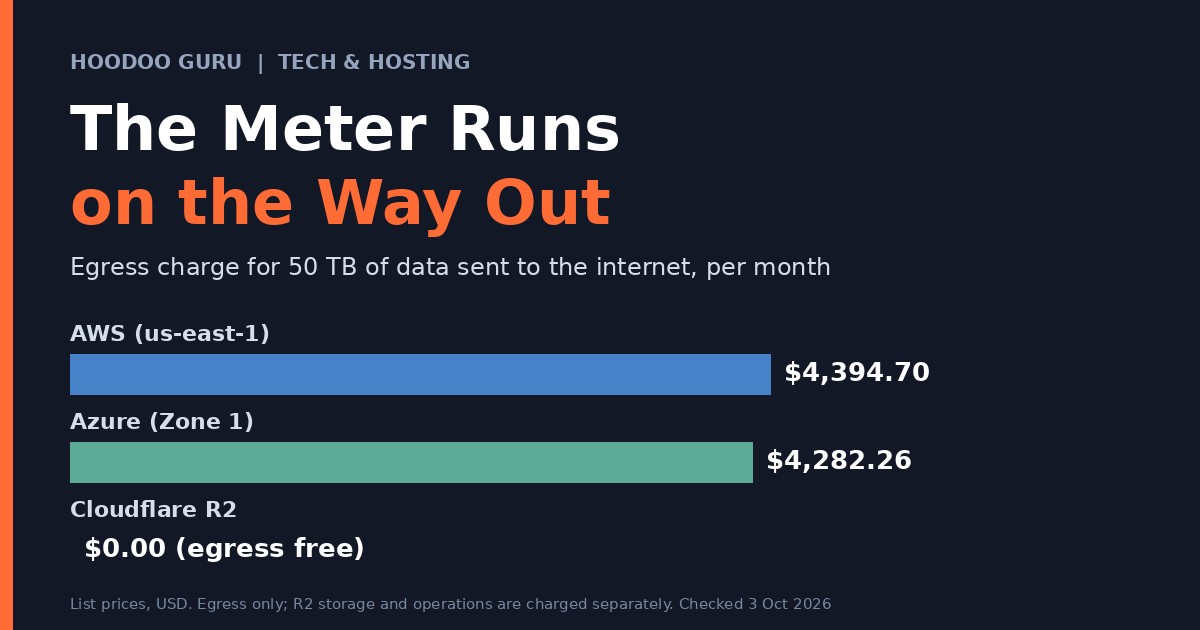
Putting data into a big cloud costs nothing. Taking it out is metered. That charge is called egress, and for a small hosting company or reseller it shows up in two places: the bandwidth bill every month, and the cost of leaving if the relationship stops working. This post puts real numbers on both and looks at what two regulators have said about it.
What the meter costs
These are list prices for data transferred out to the internet, in USD per GB. AWS’s figures come from its published price file for US East (N. Virginia), dated 16 September 2026. Azure’s come from its bandwidth pricing page, for North America and Europe. Both give the first 100 GB each month free.
| Monthly volume | AWS (us-east-1) | Azure (Zone 1) |
|---|---|---|
| First 100 GB | Free | Free |
| Next 10 TB | $0.090 | $0.087 |
| Next 40 TB | $0.085 | $0.083 |
| Next 100 TB | $0.070 | $0.070 |
| Above that | $0.050 (over 150 TB) | $0.050 (next 350 TB) |
I haven’t included Google Cloud’s rates, because its pricing page wouldn’t give me figures I could check.
What that adds up to
Take a host serving customer traffic from a cloud server, and count only the egress charge: no compute, no storage, no CDN, one region, no committed-spend discount, and 1 TB counted as 1,024 GB.
| Egress per month | AWS | Azure |
|---|---|---|
| 10 TB | $912.60 | $882.18 |
| 50 TB | $4,394.70 | $4,282.26 |
That works out to roughly 8 to 9 cents for every gigabyte that leaves, however much you sell it for. A hosting plan that includes a bandwidth allowance is quietly carrying that cost, and it grows with the customer’s success.
The exit waivers
In early 2024 all three big providers announced they would waive the fee for customers who leave entirely. Google went first, on 12 January 2024: customers who want to move their data to another provider or on-premises “can take advantage of free network data transfer”, and “this applies to all customers globally”. AWS followed on 5 March 2024. Its programme covers any customer moving data out of AWS, but you have to contact AWS Support, credits are applied only after approval, and you get 90 days to complete the move. AWS also says it applies “additional scrutiny if the same AWS account applies multiple times”. AWS says the policy “follows the direction set by the European Data Act”. Azure’s FAQ says it “offers free egress for customers leaving Azure”.
The waivers are real, but they are narrow. They cover a one-off, complete departure, which you have to request and justify. They don’t help a business that wants to keep part of its workload where it is and move the rest, and they don’t touch the monthly bandwidth bill. AWS also says over 90% of its customers already pay no data transfer out charges because of free tiers. That is AWS’s claim and I can’t test it, but it fits the pattern: customers with small footprints barely notice the meter, while the ones with data worth moving feel it most.
What the regulators found
The UK CMA published its final cloud market decision on 31 July 2025. It found that “competition is not working well”. Microsoft and AWS each held 30 to 40% of the UK and European Economic Area infrastructure market in 2024, and Google held 5 to 10%. Fewer than 1% of customers switch cloud provider in a year. On egress, the CMA wrote that “a key commercial barrier is the presence and magnitude of egress fees”, which “reduce the ability and incentives for customers to switch or multi-cloud, particularly smaller customers and those with large proportions of stored data”. It recommended strategic market status investigations into Microsoft and AWS. On 31 March 2026 the CMA Board announced an investigation into Microsoft’s wider business software ecosystem, but none into AWS’s cloud business, and recorded that Microsoft and Amazon “have set out actions on cloud egress fees and interoperability”, with a progress review in six months. That review falls due about now and I haven’t found its outcome. (Sources: CMA summary of final decision, CMA announcement.)
The EU went further in law. The Data Act, according to the European Commission, will “entirely remove switching charges, including charges for data egress” from 12 January 2027. Until then, providers may only charge for the costs they actually incur in switching. By my reading, that covers the cost of leaving, not the price of ordinary bandwidth. A host serving traffic every day will still pay the meter. (Source: European Commission.)
The meter is a choice
The most useful evidence that egress pricing is a business decision rather than a law of nature is that other providers have made a different one. Cloudflare’s R2 object storage lists egress to the internet as free. Backblaze B2 gives free egress up to three times the data you store each month and charges $0.01 per GB beyond that, with unlimited free transfer to partner CDNs and compute services. Storage and operations are charged separately in both cases, and these are storage products rather than full cloud platforms, so the comparison is not like for like. But on 50 TB a month of egress, the difference between about $4,300 to $4,400 and a fraction of that is not a rounding error. (Sources: Cloudflare R2, Backblaze B2.)
The opinion part
Two regulators looked at this independently. One decided the fee has to go for anyone leaving. The other found that the fees fall hardest on smaller customers and keep customers from switching, but its Board has so far not opened an investigation into AWS’s cloud business, and is reviewing voluntary steps by the two providers it was worried about. In the meantime, the big providers’ answer is a waiver you can claim once, on departure, with conditions. For a small host, the practical lesson is the one the CMA described: the cost of leaving is built in before you arrive, so the time to look at it is before you commit your data, not when you want it back.
All prices are list prices in USD, checked on 3 October 2026, and exclude tax and any negotiated or committed-spend discounts. Examples count only the egress charge and assume a single region.










Recent Comments